

Hard drive shredding: what the guidance expects
Shredding is for drives that shouldn’t be reused: drives that have failed, drives that have held sensitive data and drives your policy says must be destroyed. If you’re still deciding, our guide to wiping or shredding hard drives weighs the two up. To compare shredding with crushing, degaussing and drilling, see how to destroy a hard drive. This section covers what UK and US guidance say about shredding, the questions to ask any provider and what you receive from ZEW.
When the guidance points to destruction
The NCSC’s secure sanitisation guidance says the usual erase steps may fall short in three cases: when data could still be left on the drive, when the drive has held more sensitive data, for example personally identifiable information, and when some other factor raises the risk. In those cases it calls for the media to be physically destroyed to particles of 6mm or less, with the particle size verified afterwards, and for the drive to be erased first all the same. It treats every type of storage media the same way, from hard drives to SSDs and USB sticks.
The US guideline, NIST SP 800-88 Rev. 2 (September 2025), adds that destruction may be the only option when a drive has failed or is obsolete and can’t be cleared or purged.
NCSC and NIST compared
The UK and US references don’t treat shredding in the same way, so check which one your policy follows.
| Point | NCSC (UK) | NIST SP 800-88 Rev. 2 (US) |
|---|---|---|
| Particle size | 6mm or less, checked after destruction | No size of its own: pieces larger than your organisation accepts mean the shredding wasn’t effective |
| More sensitive data | Erase first, then destroy | Avoid shredding for anything but the lowest security categories |
| Higher-security media | Separate guidance for data classified SECRET or above | High-powered degaussers for magnetic media; melting or incineration for other media, such as SSDs |
| Degaussing | Magnetic-only media, and the degausser must be powerful enough for that drive | A purge technique, not destruction, and it can fail on flash or hybrid drives |
| Checking the result | Verify the particle size | Inspect the remnants and identify the equipment used |
NIST’s reasoning is that as data density and the hardness of drive materials increase, some destructive techniques become ineffective. Its July 2026 FAQ sets out the higher-security alternatives in the table, and our overview of UK data destruction standards explains where both sit among other standards.
Questions to ask any shredding provider
- Particle size: what size does the shredder produce, and how is it checked after each job?
- Media types: does that size suit SSDs, USB sticks and memory cards as well as hard drives?
- Serial numbers: are they recorded before shredding, so every drive can be matched to your asset list?
- Custody: how are drives secured between your premises and the shredder?
- Certificates: does each one identify the drives by serial number, with the method, date, location and person responsible, as NIST recommends?
- Waste: is the provider a registered waste carrier, and what happens to the shredded material?
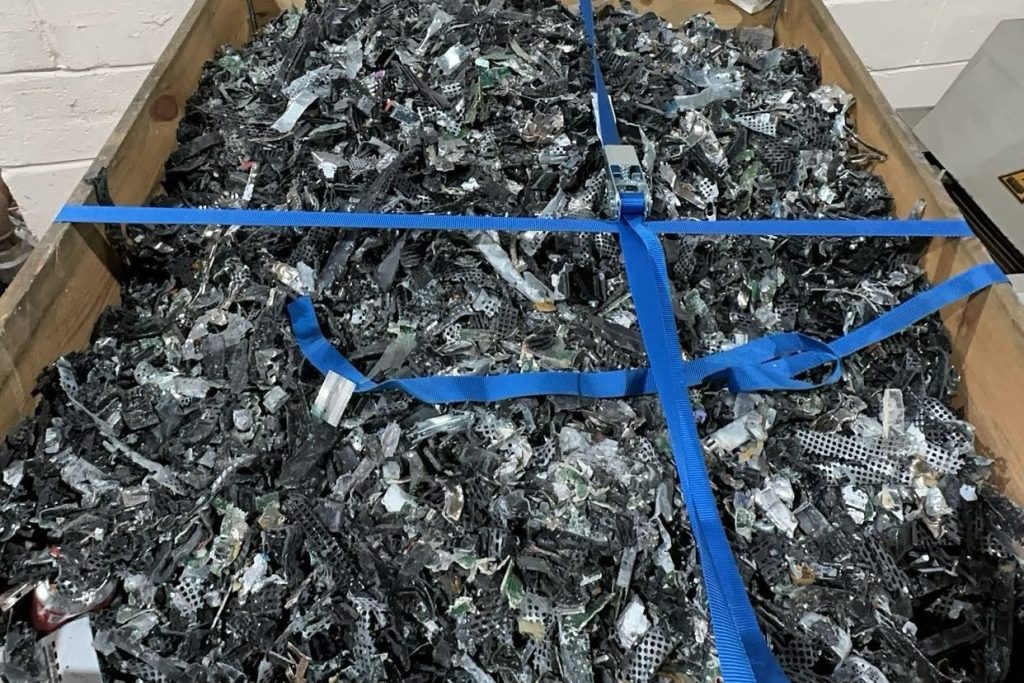

Hard drive shredding with ZEW
Collections are usually scheduled within 48 hours, and the drives we collect are moved in tamper-proof containers with a tracked chain of custody. After the job you receive serial number logs, itemised reports and certificates of destruction. On credentials, we hold ISO 9001, ISO 14001 and Cyber Essentials, we’re registered with the ICO, and the Environment Agency lists us as a registered waste carrier. If your policy sets a particle size or names a standard, include it when you ask for a quote and ask us how your drives will be handled.
Shredding and the value of your drives
A shredded drive can’t be reused or resold. On our price list, the drive grades only cover intact drives, not broken, bent or compressed ones: at the time of writing, a complete hard drive is £1.70 per kg and an SSD £1.40 per kg. Working drives that don’t need destroying can be wiped instead and still be graded. Prices can change, so confirm them on the live price list.
Hard drive shredding FAQs
Should drives be wiped before they’re shredded?
Yes, if the drive has held more sensitive data: the NCSC’s approach is erasure followed by destruction. A drive that has failed can’t be wiped, which is often why it’s being shredded.
Can SSDs be shredded?
Yes. The NCSC applies its 6mm standard to SSDs too, but NIST points to melting or incineration when an SSD has held medium- or high-security data. If you’d rather keep an SSD in use, our guide to SSD data deletion explains how to wipe one properly.
Is drilling or bending a drive enough?
Not on its own. NIST says bending, cutting or drilling a hole through a drive may only partly damage it, leaving parts readable with state-of-the-art laboratory techniques.
How should we check a certificate of destruction?
Match it against what you sent. The ICO’s disposal and deletion toolkit suggests giving a member of staff that job, and NIST notes that records are most useful when they follow each drive from the place it was last used to its destruction.
Where can I get a hard drive shredded?
ZEW shreds hard drives for businesses. We collect drives from your premises, or destroy them on site where your team can watch, and log each one by serial number for your certificate of destruction. We work across the Midlands, London and the South East, with collections available nationwide. Use the quote form or call us to book.
How is a hard drive shredded?
An industrial shredder cuts the whole drive, including its platters and circuit board, into fragments that can’t be reassembled or read. Each drive is logged by serial number before it goes in, so the certificate of destruction lists every drive in the job.
Need drives shredded? Tell us how many you have, what type they are and where they’re kept, and we’ll arrange a collection or on-site destruction. Contact us or call 020 3608 2001 (Monday to Friday, 9am to 5pm).